Zero-Knowledge Credentials for GDPR Compliance: Mathematical Privacy vs. Access-Control Privacy
For legal/compliance officers, data protection officers, and CTOs evaluating privacy architectures for government and enterprise credential systems.
The Core Conflict: Access-Control Privacy vs. Mathematical Privacy
For Data Protection Officers and compliance executives, securing sensitive identity and eligibility data across institutional boundaries has always been a game of risk management. The traditional approach relies on access-control mechanisms.
Enterprise consortium systems like Hyperledger Fabric use Private Data Collections (PDCs) to silo sensitive information. A PDC allows a defined subset of organizations to endorse, commit, or query data without creating a separate channel. The actual private data is distributed peer-to-peer via gossip protocol exclusively to authorized organizations.
The critical vulnerability: data within a PDC is stored in a private state database on the authorized peers in plaintext. The network administrator configures a policy restricting who can view the data, but authorized entities still receive it unencrypted. If an authorized node is breached, the plaintext data is exposed.
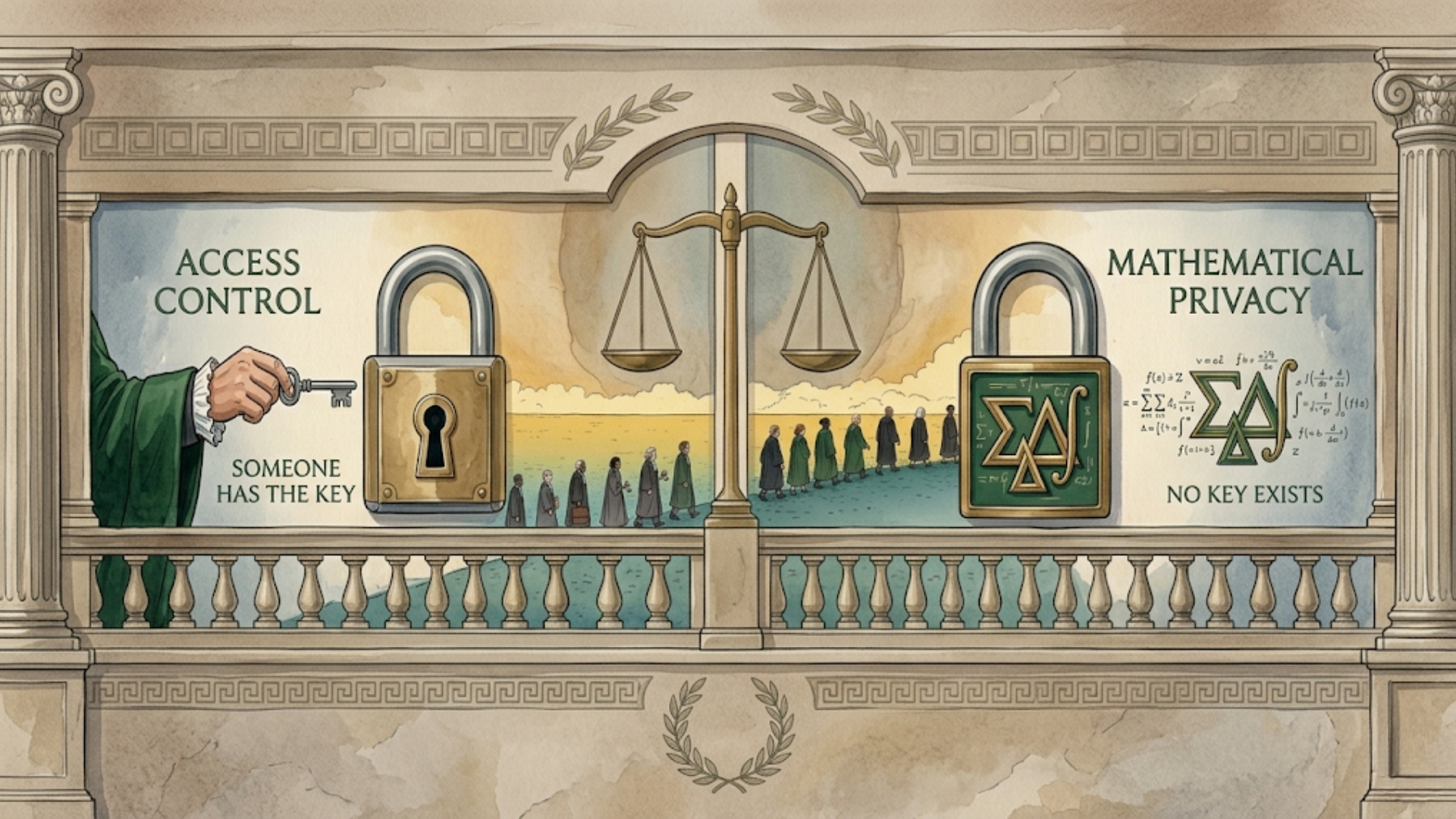
This is access-control privacy: the admin promises not to share the data.
Adduce introduces a fundamentally different approach using Groth16 Zero-Knowledge Proofs. Rather than trusting an administrator to hide plaintext data behind a firewall, Adduce ensures that the underlying private fields are never transmitted to the verifier at all. The holder generates a cryptographic proof demonstrating that a specific statement is true. The verifier checks the proof. The data never moves.
The verifier mathematically cannot extract the hidden fields, even with unlimited compute power. This is not a security policy. It is a mathematical property of the proof system.
We frame this transition simply: GDPR by cryptography, not by policy.
The Regulatory Imperative: GDPR Article 5(1)(c)
At the heart of the General Data Protection Regulation lies a principle that has consistently challenged digital identity systems: data minimisation.
In practice, this means if a service provider only needs to verify that an applicant is eligible in a specific jurisdiction, demanding a full scan of their eligibility document constitutes a violation of data minimisation, because it forces the collection of irrelevant data: exact birth dates, income levels, family status, home addresses.
Organizations have historically relied on "GDPR by policy" to manage this over-collection: privacy notices, retention schedules, promises to delete excess data. But during the period they hold that data, they carry immense liability.
With zero-knowledge proofs, data minimisation is no longer a corporate policy to be audited. It is enforced at the mathematical level. The verifier never receives the excess data, so there is nothing to retain, nothing to delete, and nothing to breach.
The eIDAS 2.0 Mandate: Selective Disclosure by December 2026
This shift from policy to cryptography is transitioning from a best practice to a legal mandate under Regulation (EU) 2024/1183 (eIDAS 2.0).
The regulation requires:
- By December 2026: every EU Member State must offer at least one digital identity wallet to all citizens and residents
- By December 2027: large online platforms, financial institutions, telecom operators, and other regulated entities must accept these wallets for authentication
- Selective disclosure is mandatory: wallet systems must allow users to share only the specific attributes needed for a transaction, not their complete identity profile
Sources: European Commission eIDAS Regulation, Identyum: Obliged Entities 2027
Under eIDAS 2.0, if a user needs to prove eligibility, they prove the attribute cryptographically and nothing else transfers. Organizations that continue full-document data collection flows will face compliance gaps requiring complete architectural rebuilds before the regulatory deadlines.
How Poseidon Commitments Shield Credential Fields
Traditional hash functions like SHA-256 are computationally expensive inside zero-knowledge circuits. Poseidon, introduced in 2019, is an algebraic hash function designed specifically to operate over prime fields, making it exceptionally compatible with ZK-SNARKs and the BN254 elliptic curve.
During credential issuance, the issuing authority does not write the citizen's personal data to the ledger. Instead:
- Each credential field (jurisdiction, tier, expiry, applicant ID, case type, issued-at) is hashed with a random salt using Poseidon
- These hashes form leaves of a Merkle tree (depth 3, supports up to 8 fields)
- The Merkle root is the commitment root, anchored on-chain
- The raw field values and salts stay with the holder, never on the ledger
Because the commitment uses random salts, it is protected against brute-force reverse-engineering. The plaintext personal data remains entirely off-chain while being mathematically verifiable.
What the Verifier Learns vs. What Stays Private
When a citizen presents their digitized eligibility certificate, they generate a zero-knowledge proof off-chain using a Circom circuit with 7,883 constraints. The proof yields 3 disclosed facts while hiding 6 sensitive fields.
| Data Element | Status | Privacy Mechanism |
|---|---|---|
| Jurisdiction | Disclosed | Exposed to route regional logic (e.g., "DE") |
| Predicate result | Disclosed | Boolean: "not expired = true" without revealing any date |
| Issuer pubkey hash | Disclosed | Poseidon hash of issuer key proves authenticity |
| Eligibility tier | Hidden | Masked within Poseidon commitment root |
| Exact expiry date | Hidden | Only the predicate ("after today") is proved |
| Applicant identity | Hidden | Wallet pubkey or hashed national ID stays private |
| Case type | Hidden | Nature of the legal matter never exposed |
| Issued-at timestamp | Hidden | When the credential was issued stays private |
| All salts | Hidden | Entropy securing the commitment root never leaked |
The verifier gains 100% mathematical certainty that the individual holds a valid, authentic, active eligibility certificate. But learns nothing about who they are, what tier they qualify for, when their certificate expires, or what kind of case they have.
Because the verifier never receives this data, they are completely insulated from the liability of storing, protecting, and deleting it. The risk of a data breach is neutralized at the architectural level.
The Compliance Comparison
| Dimension | Access-Control Privacy (Fabric PDC) | Mathematical Privacy (Adduce ZKP) |
|---|---|---|
| How data is protected | Admin configures access policy | Proof system makes extraction impossible |
| What the verifier receives | Plaintext data (restricted audience) | 256-byte proof (zero plaintext) |
| Breach risk | Authorized node compromised = data exposed | Nothing to breach (data never transmitted) |
| GDPR data minimisation | Policy-based (auditable) | Cryptographic (enforced) |
| eIDAS selective disclosure | Requires application-level logic | Native to the proof system |
| Verification cost | Consortium infrastructure | $0.0001 per proof |
| Proof size | ~500 bytes (CL signatures) | 256 bytes (Groth16) |
| Right to erasure | Must delete from peer databases | Nothing stored to delete |
Performance at Government Scale
The historical barrier to ZK adoption in enterprise environments has been computational overhead. Modern blockchain infrastructure has eliminated this.
At government scale (100,000+ cases per year per jurisdiction), these costs are negligible. The entire verification infrastructure runs on public Solana validators. No Kubernetes clusters. No ordering nodes. No consortium maintenance. Pure OpEx.
For enterprise developers, legal IT departments, and compliance officers, integrating mathematical privacy no longer requires specialized cryptographers or millions in infrastructure. The transition from access-control policies to mathematical privacy is one package:
npm install @adduce/sdkThe future of compliance is not writing longer privacy policies. It is embedding privacy directly into the proof.